Detecting sensor problems before they impact operations
(Article)
3 min read
Published
24 Sep 2026
Share
Link copied!
A camera monitoring a production process was unintentionally moved during maintenance. The change went unnoticed, and it took nearly two weeks to identify the altered camera pose as the cause of the resulting problems. It is exactly the kind of issue our new calibration approach is designed to detect almost immediately.
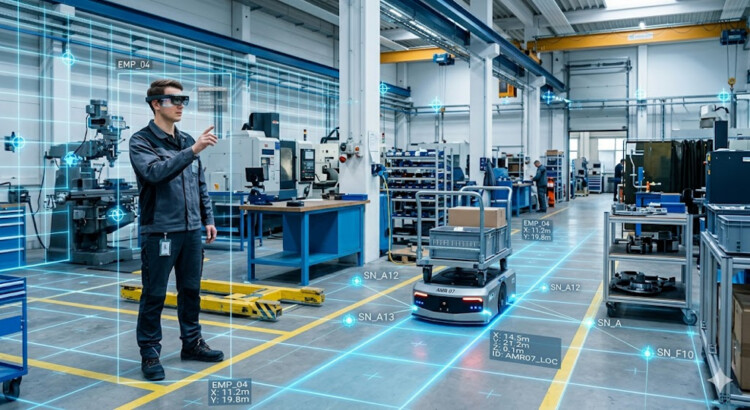
Autonomous vehicles and sensor-based industrial systems are becoming increasingly common in warehouses, factories, agriculture and logistics. As these systems rely more heavily on cameras, LiDAR and other perception sensors, one challenge becomes increasingly important: how can you ensure that sensors remain correctly aligned over time?
Even a small shift caused by vibration, maintenance or accidental contact can affect system performance, reduce operational efficiency or introduce safety risks - often without being noticed immediately. We are developing a new approach that enables continuous detection and correction of sensor pose changes during normal operation, without dedicated calibration infrastructure or lengthy downtime. Possible applications include production lines with camera systems, agricultural machinery, forklifts, trains and ships and more.
This technology increases the reliability and safety of autonomous vehicles, mobile robots and other sensor-based machines, while reducing the time needed to identify calibration problems.
Stefan Hendricx
Senior Tech Domain Lead
The challenge: A small shift can cause major problems
Autonomous and sensor-assisted systems depend on an accurate perception of their surroundings. If a sensor is no longer positioned where the software expects it to be, the system starts working with incorrect spatial information.
The effects may initially be subtle. An autonomous forklift may position itself slightly incorrectly. A production-line inspection system may become less reliable. An agricultural vehicle may gradually deviate from its intended trajectory.
A displacement of only a few millimetres or degrees can be difficult to detect visually, while still affecting system behaviour. As a result, companies may spend significant time troubleshooting software, navigation algorithms or sensor hardware before discovering that the actual problem is a change in sensor position.
The solution: continous monitoring and recalibration
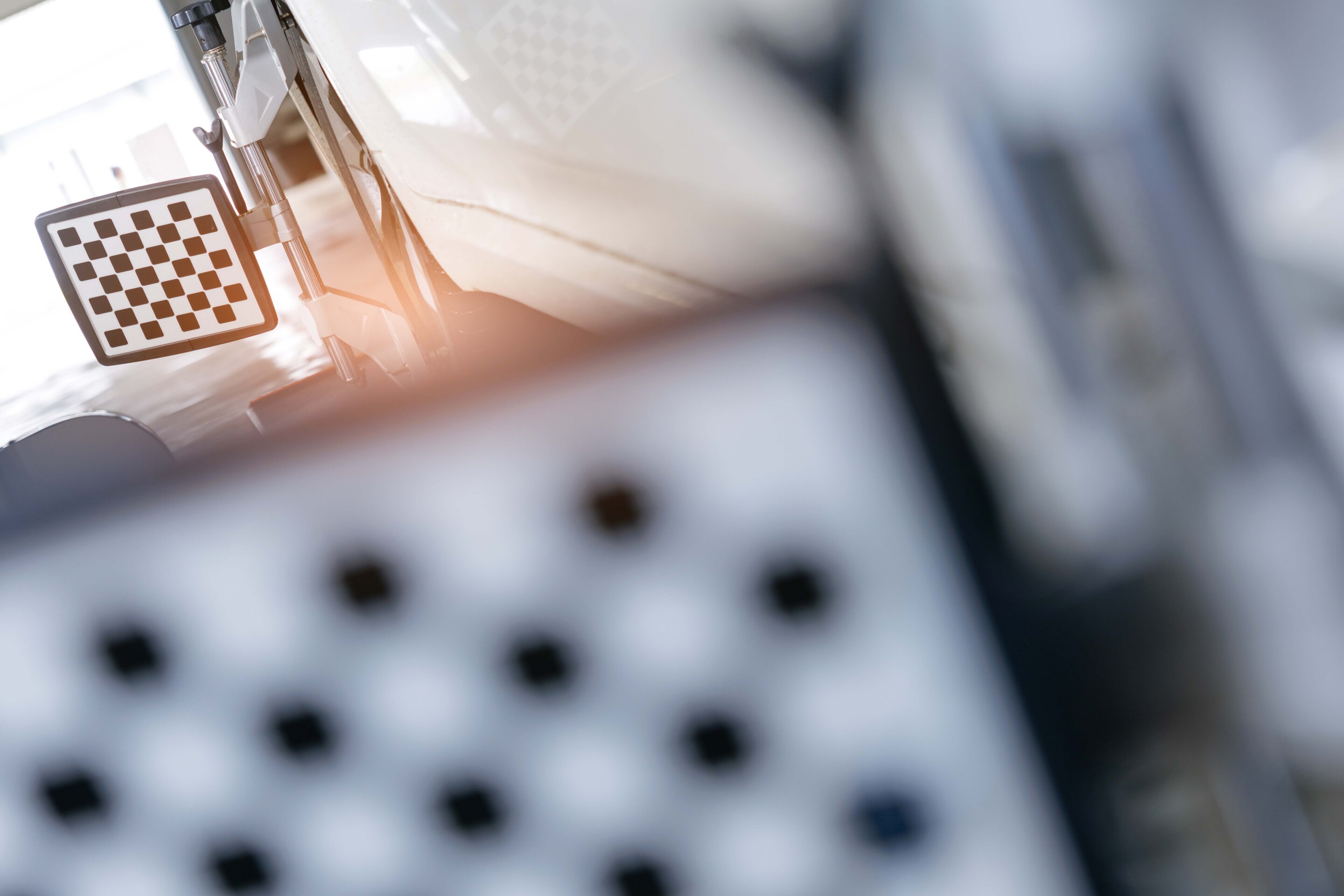
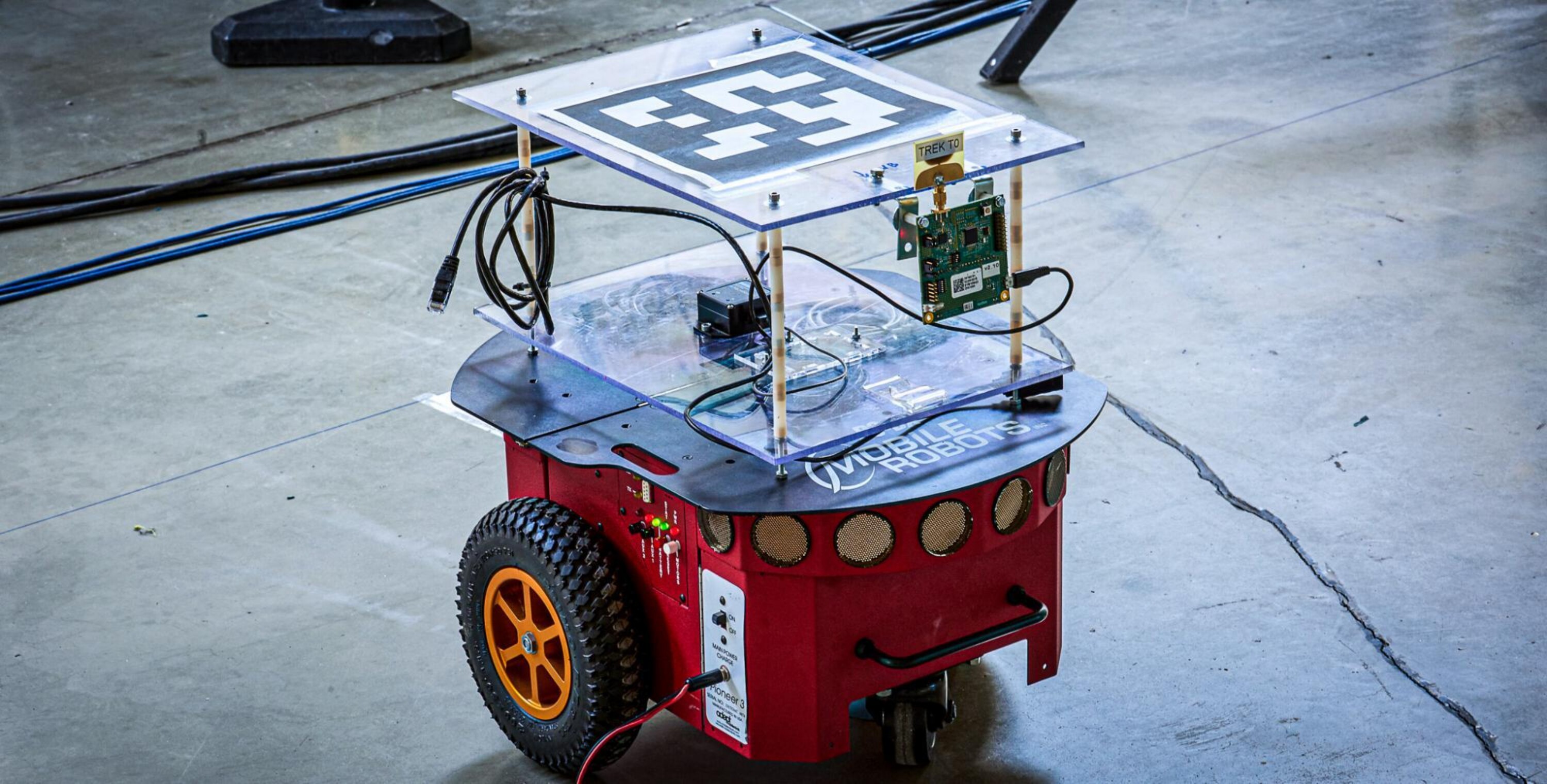
Traditional sensor recalibration often relies on dedicated procedures using checkerboards, artificial markers or specialised calibration setups. These methods work well in controlled environments, but can be difficult to apply during normal industrial operations.
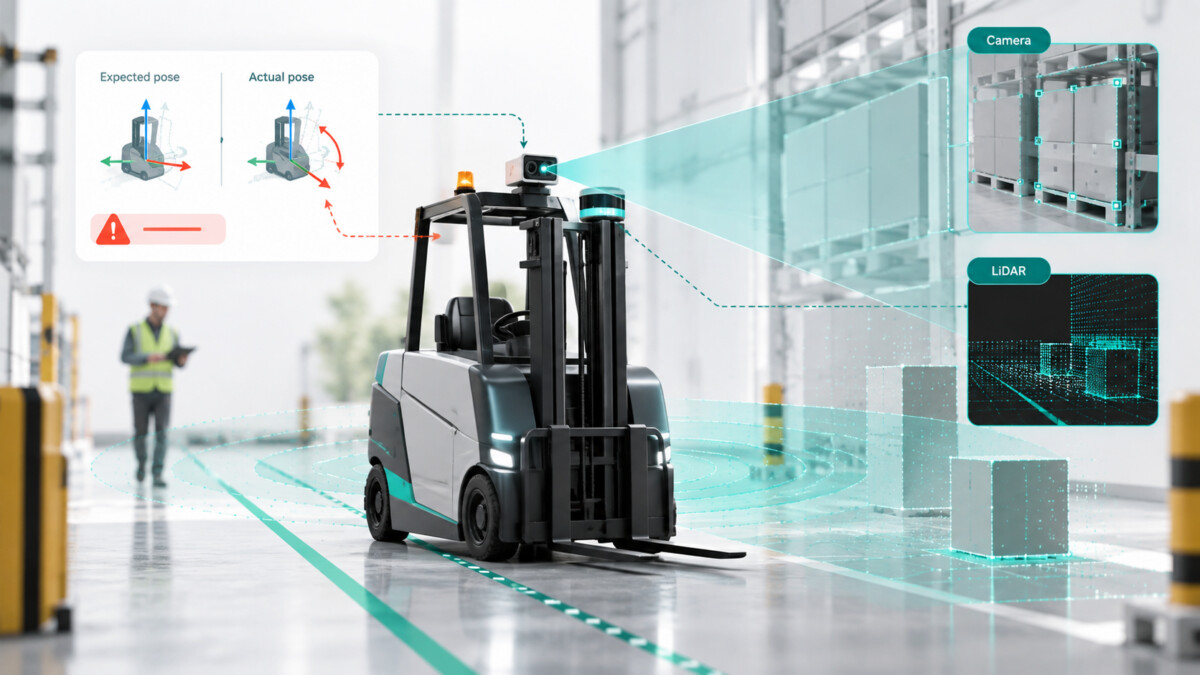
Our approach instead uses features that are already present in the environment as natural calibration references. These can include simple geometric features such as lines, planes and keypoints: for example, the horizon, railway tracks, crop rows, warehouse floors or forklift forks.
By comparing how these features are expected to appear with how they are actually observed, the system can detect whether the sensor pose has changed. This enables a shift from reactive troubleshooting to proactive monitoring. If a sensor moves beyond an acceptable threshold, the system can detect the change, generate a warning and support recalibration directly in the operational environment:
Continuous online monitoring
Algorithms for on-site recalibration
No interrupting normal operations.
Millimetre-level position accuracy in our camera and LiDAR testing
Our research has already demonstrated consistent pose estimation using simple environmental features. In tests, the monitoring system detected changes in camera position and flagged the sensor configuration as invalid. When the camera was returned to its original position, the system recognised the correction and automatically restored the status.
The proposed approach offers:
Continuous online monitoring without dedicated calibration infrastructure
Consistent pose estimation, including millimetre-level position accuracy in the tested setups
A modular approach that can be applied to cameras, LiDAR and IMUs
As more industrial systems depend on autonomous operation and sensor data, maintaining reliable perception becomes increasingly important. Continuous sensor pose monitoring can help companies detect calibration problems earlier, reduce troubleshooting time and maintain system performance without taking equipment out of operation for dedicated recalibration.