Smart Tools to Drive the Future of EV Thermal Management

Electric vehicles (EVs) are becoming more powerful and efficient, but keeping their components cool remains a challenge.
Electric vehicles (EVs) are becoming more powerful and efficient, but keeping their components cool remains a challenge. Traditional cooling systems often use multiple fluids for different parts, such as the motor, battery, and inverter. However, a new approach is emerging: using a single dielectric oil for both cooling and lubrication. This method allows direct cooling of critical components, resulting in a more compact design, increased energy efficiency, and improved safety.
(Re)watch our March 25th Tech@Lunch webinar on this topic:
The challenge of novel integrated cooling
While using a single cooling and lubrication fluid sounds great, designing an efficient novel single e-fluid system is complex. Each component has different cooling requirements, and how they are connected - whether in series, in parallel, or through different heat sink designs - can affect performance. Traditionally, engineers have relied on experience and trial and error to design these systems. However, this approach limits the number of possible designs that can be tested, meaning that some potentially better solutions may be overlooked.
A smart approach to automatically design novel architectures
To overcome this challenge, we have developed an intelligent, web-based tool that automates the process of designing and evaluating novel cooling systems. Instead of manually testing a few configurations, our tool generates and analyzes thousands of possibilities in minutes. Using advanced computational techniques such as constraint programming, parallel computing, and system simulation, it identifies the most efficient system designs based on key performance indicators (KPIs) such as thermal efficiency and energy consumption.
How it works

- Preparation of Component Library: The tool starts with an existing EV cooling system design from which a library of components are extracted and can be expanded with alternative options.
- Automatic Design Generation: The user sets high-level constraints, such as ensuring that a particular component is included in every circuit or even a prescribed order of certain components.
- Performance Evaluation: Each design is converted into a simulation model (Matlab Simscape™ in our use case) and evaluated against user-defined KPIs.
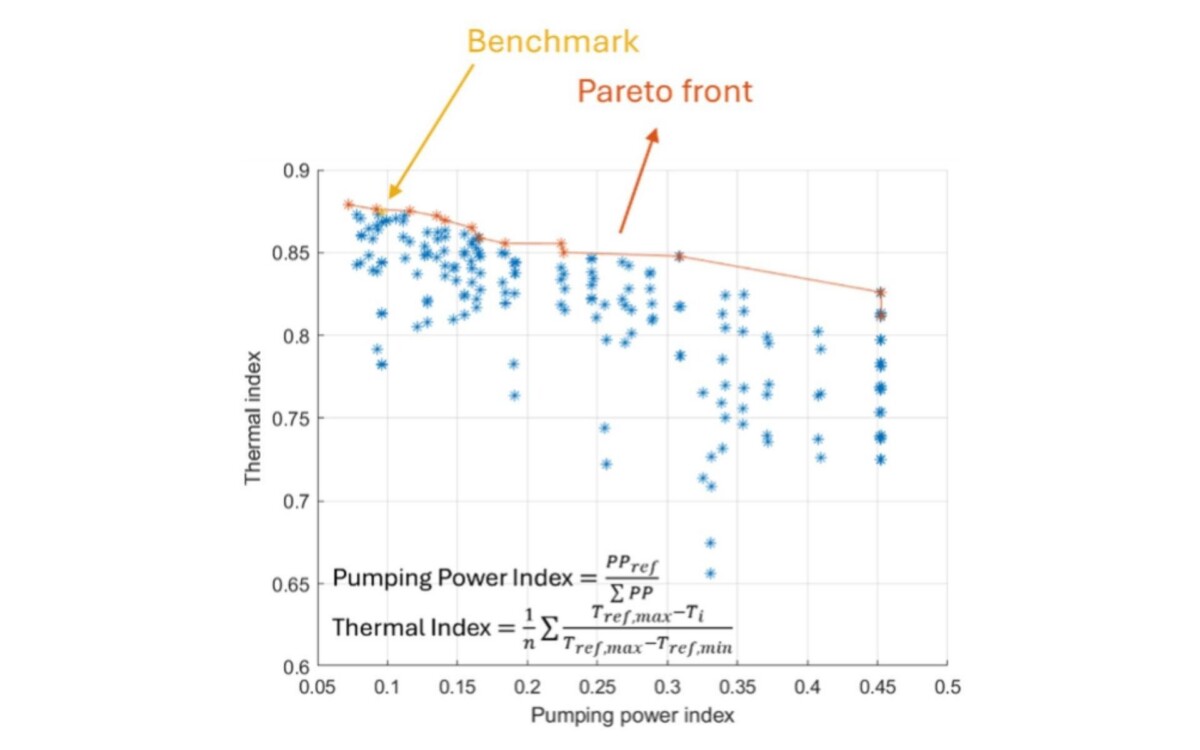
- Ranking & Selection: The best designs are ranked based on a Pareto front, which identifies optimal tradeoffs between competing performance metrics - improving one aspect, such as thermal efficiency, may require compromising another, such as power consumption.
- Manual Refinement: System engineers can then review and refine the most promising architectures.
Real-world application: e-Evoque
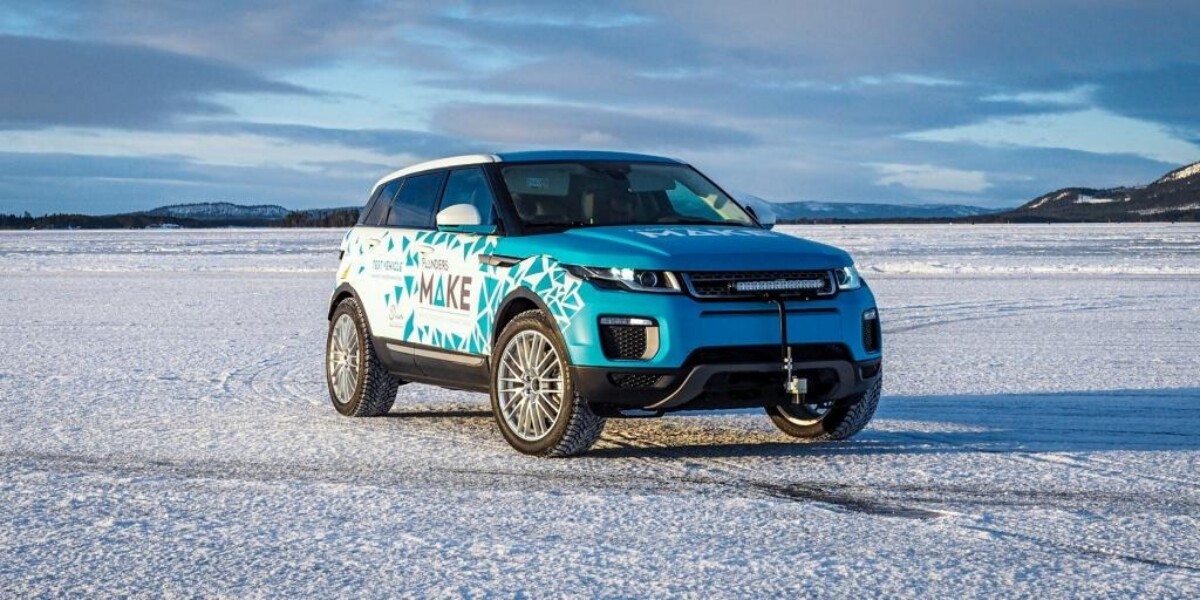
To test our tool, we applied it to the e-Evoque, our electric research vehicle. The system was designed for a single-wheel drive setup, including a fluid pump, inverter heat sink, motor cooling methods, and a DC-DC converter. In total, 225 different thermal architectures were generated and simulated in just 4 minutes. After evaluating the KPIs, 16 Pareto optimal configurations were identified. While the benchmark design performed close to the Pareto front, new alternative architectures were identified which allowed for better trade-offs between KPIs depending on specific application needs.
The future of EV cooling design
Our tool simplifies and accelerates the design of complex thermal management systems, helping engineers find viable solutions faster and with greater accuracy. But we keep moving forward:
We will continue refining the tool by incorporating additional new cooling methods (immersion cooling) for each drivetrain component. More specifically, we are currently also working on developing validated novel direct contact or immersion cooled battery and power electronics concepts and methods.
By integrating these models as well as indirect and direct cooling models from past projects, we will introduce an additional topological parameters for each component, enabling even more precise and adaptable system designs for electric vehicles. Further, the tooling will also be generalized to support other disciplines such as electrical and mechanical systems.
How We Can Support You
With our smart tools, we can optimize your thermal architectures and help design innovative, efficient cooling solutions for your electric powertrains.
Our expertise includes:
- Thermal Architecture Optimization: Using automated design tools, we identify the most efficient cooling configurations.
- Experimental Validation: We validate e-fluid powertrains and components through our flexible e-fluid circuits and HiL infrastructure.
- Custom Cooling System Design: We develop and refine e-fluid cooled powertrain components, including novel, robust motor cooling concepts.
Learn more about our services:
Novel Robust Power-Dense Motor E-Fluid Cooling Concepts
Testing with Active Cooling & Lubrication System
Technologies

Power and Energy Components and Systems
Advancing electric machines, batteries, power electronics, transmissions and thermo-fluid energy systems.
Contact us
Interested in optimizing your EV’s cooling performance?