Digital twins push Flemish industry to the top of the world
(Article)
4 min read
Published
27 Feb 2026
Share
Link copied!
Digital twins are currently among the most promising technologies for industry. By 2030, the global market is estimated to be worth 115 billion euros (1). We are also investing heavily in this technology and are working closely with industrial partners to this end. For example, FlandersMake@KULeuven is collaborating with Siemens to investigate how digital twins can create maximum value within industrial applications.
How do you optimise the energy efficiency, sustainability or noise and vibration behaviour of a system that does not yet physically exist? You can do this with a digital twin: a digital representation of a product, system or process that allows performance to be analysed and improvements to be tested safely and cost-effectively.
Digital twins originated in space travel. As early as the 1960s, NASA used virtual replicas to analyse technical problems during missions. In the 1980s and 1990s, the technology found its way into industrial design and process applications. In recent years, the use of digital twins has accelerated rapidly, driven by the further digitisation of industry and extensive research at knowledge centres such as Flanders Make.
Leverage for the industry
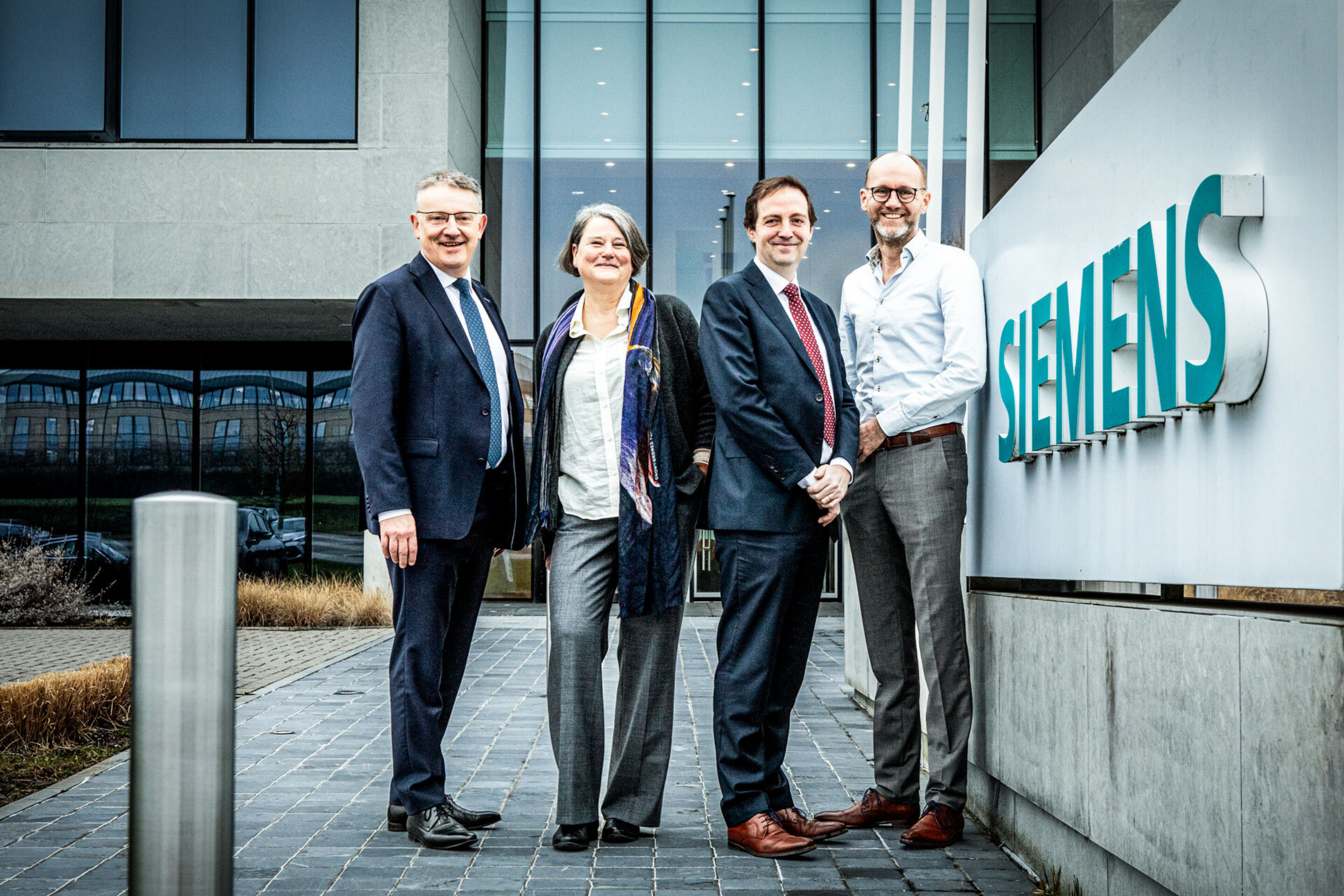
FlandersMake@KULeuven and Siemens are building on their complementary expertise to deploy digital twins more widely and efficiently in an industrial context. Professor Wim Desmet and research manager Bert Pluymers are working closely with Siemens experts Katrien Wyckaert, Vice President of Innovation, and Matthieu Worm, specialist in digital twins.
‘Together with Siemens, we are translating theoretical insights into concrete industrial applications. By effectively implementing concepts, we are achieving tangible improvements in productivity and competitiveness,’ says Desmet. ‘The collaboration brings market pull and technology push together in a strong synergy. We reinforce each other in all areas.’
The collaboration between Flanders Make and Siemens creates a strong synergy between market pull and technology push. We complement each other perfectly.
Wim Desmet
Professor FlandersMake@KULeuven
Engine for innovation
‘Today, a significant part of the potential of digital twins lies in software,’ says Wyckaert. ‘Products are increasingly equipped with active components, sensors and intelligent control systems. This enables highly targeted and innovative solutions. Thanks to Flanders Make’s expertise and extensive network, we can make the most of that potential.’
Products are becoming increasingly intelligent, enabling highly targeted new solutions. Digital twins are constantly evolving alongside them.
Katrien Wyckaert
Vice President Innovation bij Siemens
‘The green transition is also stimulating ongoing innovation within our digital twin applications,’ Wyckaert continues. ‘The switch from combustion engines to electric vehicles requires continuous optimisation. Think of the development of advanced battery cooling systems or improving the sound quality of integrated electric motors. Together with FlandersMake@KULeuven, we are developing targeted digital twin technology for this purpose.’
‘A concrete example that is already benefiting the industry today is personalised digital twins that are effectively deployed in production environments,’ says Bert Pluymers. ‘These virtual models continuously analyse machine usage data. This makes maintenance predictable and extends the service life of installations.’
Strong partnership
‘The possibilities for application extend much further,’ adds Matthieu Worm. ‘Consider, for example, the combination of artificial intelligence and digital twins. AI models can be trained in a more targeted manner with input from digital twins. In addition, we can increase the reliability of AI by systematically testing generated results against validated digital models.’
Such forward-looking initiatives are perfectly in line with Flanders Make's ambition. ‘Our engineers have been among the best in the world for many years,’ concludes Desmet. ‘Their expertise comes into its own in collaborations such as this. That requires investment, mutual trust and shared knowledge. It is precisely these elements that make this partnership so strong. I am convinced that this type of strategic collaboration is essential for the future of our industry.’
Virtual Worlds Association
The collaboration in Flanders also translates into the European research agenda. Siemens and KU Leuven are co-founders of the Virtual Worlds Association: the representation of academia and industry in the Horizon Europe partnership with the European Commission for virtual worlds and digital twins.
In this partnership, at least €400 million will be invested in strengthening the European ecosystem in the coming years.