Replacing hundreds of sensors by cameras in dynamic testing?
Can cameras replace hundreds of sensors in dynamic testing?
When engineers want to understand why a machine vibrates or deforms they typically rely on extensive measurement campaigns. Accelerometers, strain gauges and other sensors are attached to the system, generating data from a limited number of locations.
While this approach remains valuable, it is often expensive, time-consuming and intrusive. Moreover, it only provides insight at specific measurement points, making it difficult to understand how an entire structure behaves.
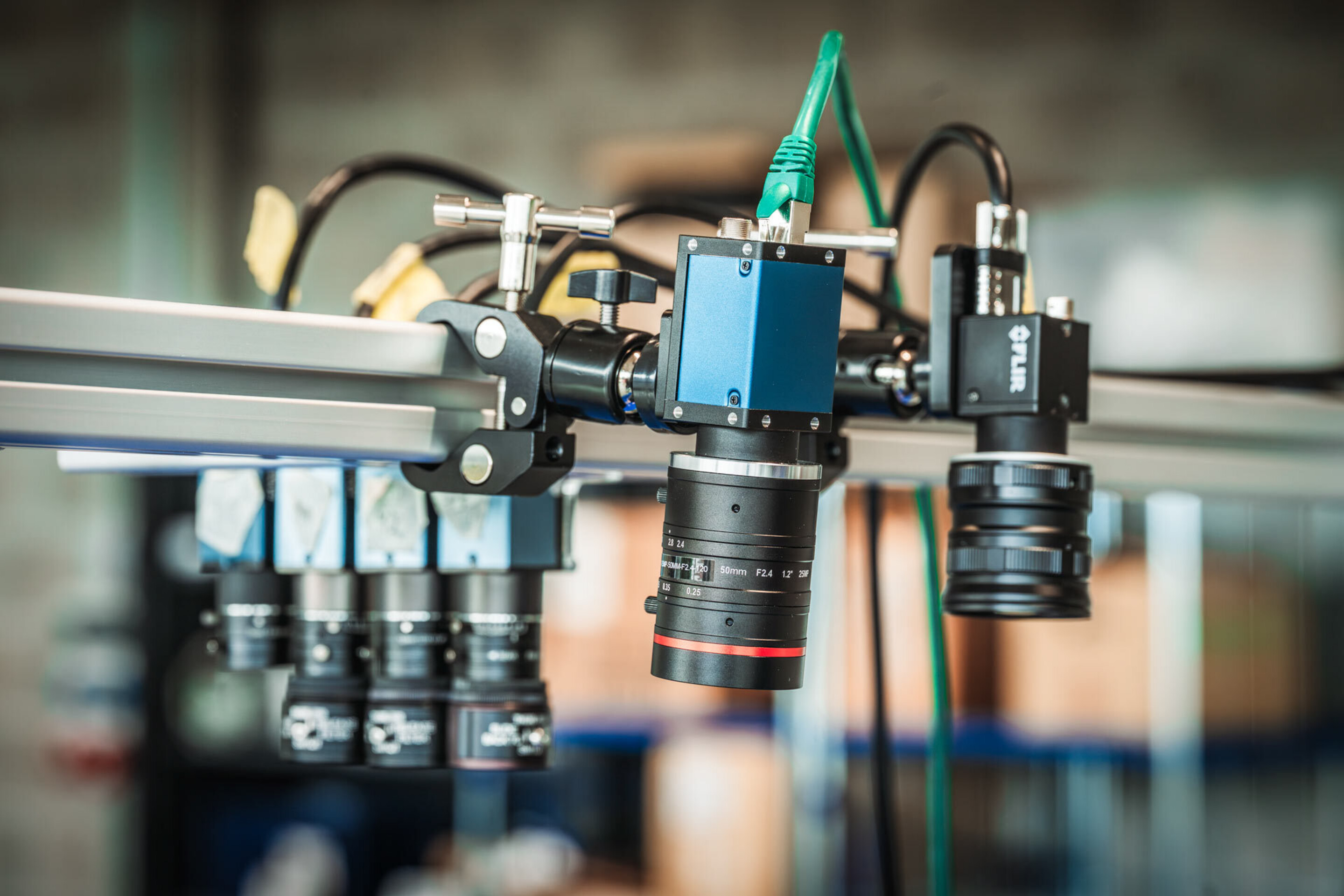
Within the DynaCam project, researchers at FlandersMake@KULeuven are exploring a different approach: using camera-based measurement technologies to capture the dynamic behaviour of complete systems in a fast, non-contact and high-resolution way.
From discrete measurements to full-field insights
Traditional dynamic testing relies on discrete sensors that provide information at individual locations. For complex mechatronic systems, this can result in lengthy setup times and limited visibility into the overall behaviour of the machine.
We investigated how high-speed cameras and advanced image-processing algorithms can transform this process. Instead of measuring a handful of points, cameras capture the motion of an entire structure simultaneously, allowing engineers to visualise both global movements and local deformations.
This opens the door to:
- Faster measurement campaigns
- Reduced instrumentation costs
- Non-intrusive testing
- Higher spatial resolution
- Improved understanding of complex dynamic behaviour
Tackling three key technological challenges
The project addresses three major barriers that currently limit the industrial adoption of camera-based dynamic testing.
- Combining data from multiple heterogeneous cameras
Industrial systems are often too large or too complex to be captured by a single camera. Within this project, we therefore develop methods that combine information from multiple heterogeneous cameras that operate at different frame rates or resolutions. A major breakthrough is the development of self-calibration approaches that significantly reduce setup time while maintaining measurement accuracy. The project has also developed workflows that allow synchronous and asynchronous frame cameras, such as event cameras, to work together, creating a more flexible and cost-effective measurement setup. - Separating motion from deformation
Understanding the difference between rigid-body motion and structural deformation is crucial for diagnosing dynamic problems. DynaCam has developed motion-tracking toolboxes capable of extracting both types of information from camera measurements. The methods have already been demonstrated on industrial cases such as weaving machinery and rotating tyres. These techniques enable engineers to identify vibration modes, analyse deformation patterns and gain deeper insight into system behaviour without relying on extensive sensor networks. - Extending the frequency range through sensor fusion
One limitation of conventional cameras is that their frame rate can restrict the frequency range that can be analysed. To overcome this challenge, we combine camera measurements with data from discrete sensors such as accelerometers. Using advanced sensor-fusion techniques, including Kalman filtering, researchers can reconstruct high-frequency motion with improved accuracy. Early results show a significant reduction in measurement errors, demonstrating the potential of hybrid sensing approaches for dynamic analysis.
Event cameras: a promising new technology
One of the most innovative aspects of our research is the use of event cameras.
Unlike conventional cameras that capture complete images at fixed intervals, event cameras only register changes in light intensity. This results in:
- Extremely high temporal resolution
- No motion blur
- Lower data volumes
- High dynamic range
These characteristics make event cameras particularly attractive for vibration analysis and high-speed motion tracking.
The project is investigating how event-camera data can be combined with conventional camera measurements to exploit the strengths of both technologies while compensating for their individual limitations.
Towards digital twins and predictive engineering
Beyond measurement itself, DynaCam is creating new opportunities for model identification and digital twin development.
The project has developed methodologies that use camera measurements to identify multibody models directly from observed system behaviour.
Researchers have also developed visualisation tools that overlay measured deformations onto photorealistic 3D models, making results easier to interpret and communicate.
Industrial validation already underway
The developed methodologies are already being evaluated together with industrial partners including Atlas Copco, SEW-Eurodrive and Siemens.
To facilitate the industrial uptake, the researchers have also developed a platform that provides guidelines and calculation tools to support the preparation of camera-based dynamic measurements. It includes the "DynaCam Camera Configurator" that estimates field of view, depth of field, and measurement accuracy based on cameras parameters and positioning.
The feedback from the user group confirms the relevance of the project and highlights its potential for practical industrial adoption.
Looking ahead
At the midpoint of the project, we have already demonstrated that camera-based dynamic testing can provide valuable alternatives to traditional sensor-intensive measurement campaigns.
The next phase will focus on further improving motion tracking, extending sensor-fusion techniques and integrating the developed “DynaCam Camera Configurator” into the Flanders Make Solutions Hub.
Ultimately, DynaCam aims to make dynamic testing faster, more accessible and more informative, helping manufacturers gain deeper insight into the behaviour of their products while reducing testing effort and cost.
In short: by turning cameras into measurement instruments, DynaCam is helping industry move from sparse sensor data to full-field dynamic intelligence.