PERI develops robots for safer and more efficient scaffolding assembly
“With robot-assisted scaffolding assembly, PERI demonstrates how digitalisation and robotics can contribute to safer, more ergonomic and more efficient construction processes.”
The challenge: making scaffolding safer, lighter and less labour-intensive
In the construction sector, safety, ergonomics and labour shortages remain major challenges. This also applies to the erection of industrial access and facade scaffolding, where many heavy and repetitive tasks are still carried out manually, often in changing and difficult-to-predict site conditions. For PERI, this presented a clear question: how can scaffolding be erected more safely, consistently and quickly, with less physical strain on workers and less reliance on scarce labour?
To tackle this challenge, PERI collaborated with Flanders Make@KULeuven and other European research partners – SDU, RWTH, JSI and UCLL – on a robot-assisted solution for scaffolding erection. Within this collaboration, Flanders Make contributed expertise in mobile robotics, navigation in dynamic environments, computer vision for the recognition and placement of scaffolding components, and simulation and design validation with a view to industrial applicability.
From digital workflow to collaborative rack robot
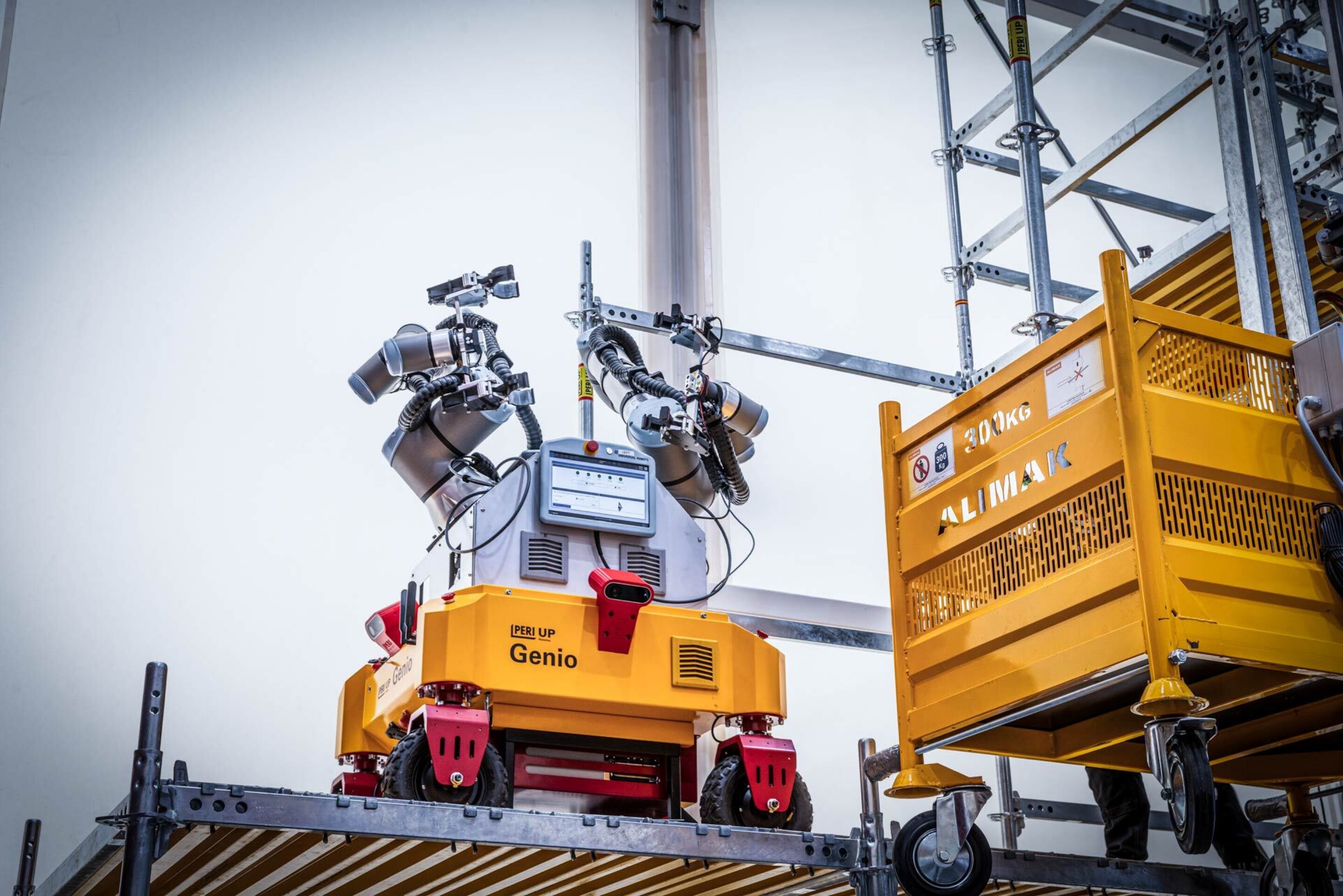
The result is a collaborative, mobile rack robot capable of picking up, positioning and assembling components. This robot forms part of a broader digital workflow: the scaffolding structure is first modelled in CAD/BIM, then an assembly sequence is automatically generated, after which a central orchestrator coordinates the collaboration between the robot and the operator. Staff continue to play a key role in preparation, supervision and fine-tuning.
The robot combines a mobile platform with two collaborative robotic arms and advanced vision and sensor technology. Thanks to 360° 3D environmental perception and adaptive navigation, it can operate safely in narrow, changing and human-shared spaces — precisely the conditions in which traditional automation is often difficult to deploy.
This delivers clear added value for PERI and its customers. The robot helps to reduce manual lifting and working at height, supports teams in a context of labour shortages, and simultaneously increases the repeatability and quality of the assembly. Productivity and traceability are also improved, as human fatigue is reduced and assembly steps can be digitally tracked.
Added value for PERI and industry recognition
The prototype was successfully demonstrated to customers and at international trade fairs, including BAUMA 2025 in Munich. The solution has also already received industry recognition in the form of the Dobbit TV Innovation Award.
For PERI, this development forms part of a broader strategy to further digitise and industrialise construction processes. At the same time, the collaboration demonstrates how robotics can also be deployed outside the traditional factory environment, even in complex and unstructured settings such as construction sites. Thanks to the collaboration with Flanders Make, research findings could be rapidly translated into a robust industrial prototype, with a focus on safety, regulations and practical applicability.
More about the used technology

Robotics, sensors and actuators
Improving the core components of robotics and smart machines.